
Walther MPK – An Overlooked Submachine Gun from the 1960s
- Marco Damaso

- Aug 28
- 10 min read
Introduction
Around the year 2000, I was doing a great deal of research on modern special forces for my work. Like many others, I came across that famous picture of four operators in sage green jumpsuits, sneakers, and baseball caps, preparing to enter a room while armed with Walther MPK submachine guns. The caption identified them as early Delta Force operators, and like many people, I believed for a long time that Delta Force had indeed used Walther MPK submachine guns, among other operations, during the Eagle Claw mission. But was that really true? And what exactly is this rather unknown weapon?
During the Cold War, the United States deployed a clandestine unit in West Berlin designated as the 39th Special Forces Detachment (Airborne), commonly known as Detachment A or simply Det A. Det A was tasked with conducting operations behind enemy lines in the event of a conflict with the Soviet Bloc, including sabotage of key targets and the organization of stay-behind resistance in East Germany. Its existence and activities remained highly classified throughout its service. Det A also participated in Operation Eagle Claw. Its mission was to rescue the hostages held at the Iranian Ministry of Foreign Affairs. In support of this operation, a two-man Det A element infiltrated Tehran undercover in advance, providing eyes-on reconnaissance and pre-mission intelligence.

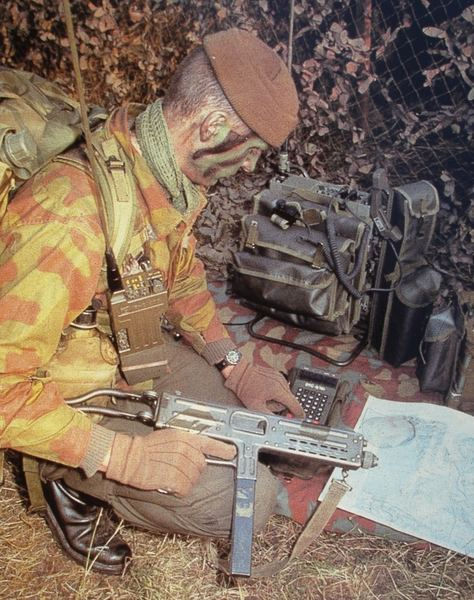
Det A used a variety of submachine guns, notably the Ingram MAC series, the STEN, and - most famously - the Walther MPK, which became one of their preferred weapons. Their sidearms initially included Walther P38/P1 pistols. These were later replaced by Walther P5s, reportedly because the alloy frames of the P38/P1s were prone to cracking under the intense and repetitive CQB training conducted by the unit. The well-known photographs of operators in sage green jumpsuits, sneakers, and baseball caps carrying Walther MPKs are in fact images of Det A personnel, not early Delta Force operators as is often assumed. They also employed a suppressed version of the MPK, which was reportedly taken along for Operation Eagle Claw.

You can read about the largely unknown role of U.S. Army Special Forces Detachment A in the 1980 attempt to rescue American hostages in the book Mission Iran: Special Forces Berlin & Operation Eagle Claw, JTF 1-79 by James Stejskal. The book covers advanced reconnaissance, mission planning, and the aftermath of the failed operation. It also sheds light on Detachment A’s covert activities in Tehran and their contribution to the overall rescue effort, a role often overlooked in most accounts of Operation Eagle Claw.

The Walther MPK
In the late 1950s, Walther began designing the Maschinenpistole (MP) in line with the military and police rearmament programs of West Germany. Walther produced approximately 27,000 submachine guns between 1963 and 1985 in two main variants: the long-barreled MPL and the shorter MPK. Despite its excellent features, the weapon arrived relatively late. Similar third-generation submachine guns such as the Czech Samopal model 23 (1948) and the UZI (1954) had already established themselves, while the Heckler & Koch MP5 - introduced in 1966 - soon became the standard submachine gun for many Western police and special forces units. Nevertheless, the MPL/MPK saw service in various countries across Europe, Africa, and South America, as well as with units such as Det A. Among others, the Portuguese Naval Special Forces used it until 1989.

In 1964, Walther developed a suppressor for use with their MPK submachine gun. They were the first German arms manufacturer to receive a special permit to produce suppressors. The MPK’s barrel configuration allowed the suppressor to be mounted without obstructing the weapon’s sights - an important practical advantage. These suppressors were used by West German intelligence personnel and by Detachment A stationed in West Germany. The suppressor featured a tube approximately 25 cm (10 inches) long with a diameter of about 5 cm (2 inches).

As I have always been passionate about small arms—particularly submachine guns—as well as special forces history, I was naturally very interested in trying this forgotten weapon. Today, however, fully functional Walther MPL/MPK submachine guns are quite rare. Fortunately, I had the opportunity to test-fire a fully automatic Walther MPK on the range, and I will share my impressions of this rather uncommon weapon.
Description
The Walther MPL/MPK belongs to the so-called third generation of submachine guns developed after World War II. These weapons are characterized by two major innovations: the telescoping (or enveloping) bolt, which enables a shorter overall weapon length and/or the use of a longer barrel, and the introduction of enhanced safety mechanisms. Other representative examples of this generation include the Israeli UZI and the Czech Model 23.

The MPL/MPK is constructed from stamped sheet metal components. The folding stock consists of a bent and shaped steel tube, partially coated with PVC for improved comfort and handling. The trigger guard is notably large, allowing easier operation while wearing gloves. It uses a straight 32-round 9×19 mm magazine.
Early models were designed for full-automatic fire only, while later versions introduced a fire selector allowing the shooter to choose between semi-automatic and full-automatic fire. A particular feature was the ambidextrous selector layout: the first position selected full-auto, while the second position selected semi-auto - similar to the arrangement found on the AK-47.
 |  |
The weapon operates on an open-bolt blowback system. Although it does not feature a true telescoping bolt, the massive bolt carrier rides over the rear portion of the barrel, shifting the mass forward and contributing to a more compact overall design and improved balance. The non-reciprocating cocking handle is located on the upper left side of the weapon. A particular feature is that, when the cocking handle is pressed inward, it engages the bolt and allows the shooter to manually control its movement (reciprocating), which is useful for clearing stoppages. Additionally, if the bolt is moved rearward unintentionally or incompletely - such as when the weapon is dropped - a safety mechanism locks the bolt in place, preventing inadvertent firing. This arrangement is similar to the safety system found on the UZI.
The sighting system is also quite distinctive. The MPL/MPK features two separate sighting arrangements: an open sight for close-range engagement and a diopter sight for more precise shooting at longer distances. The diopter aperture, however, is very small and not particularly practical under field conditions, especially for rapid target acquisition. For close-range shooting, the shooter uses a simple notch located on top of the rear sight housing, aligning it with the top of the front sight protector rather than with a conventional front sight post.

General characteristics:
| MPL | MPK |
Length stock extended | 746 mm (29.3 inch) | 659 mm (26 inch) |
Length stock folded | 460 mm (18.1 inch) | 353 mm (13.9 inch) |
Weight weapon | 3 kg (6.6 lbs) | 2.8 kg (6.2 lbs) |
Weight magazine | 0.2 kg (0.45 lbs) | 0.2 kg (0.45 lbs) |
Rate of fire | 550 rds/min | 550 rds/min |
Barrel length | 260 mm (10 inch) | 173 mm (6.8 inch) |
Undoubtedly, the Walther MP bears some resemblance to the Italian Franchi LF-57 submachine gun, which - as its name suggests - was introduced in 1957. Only around 30,000 LF-57s were produced, and they were used primarily by the Italian Navy, including the naval special forces unit COMSUBIN, as well as by mercenaries during the Portuguese colonial wars. Although there are many differences between the two weapons, I strongly assume that Walther was at least inspired by the Franchi LF-57 when developing their own submachine gun.
On the range
Lately, I have done extensive test firing with various submachine guns. Even more than with pistols, ergonomics, sights and rate of fire play a major role in practical performance. A submachine gun is not designed to deliver precise 10 cm headshots at 100 meters, but rather for close-quarters battle, where compact size and controllable rapid fire are what truly matter. In previous tests, I found the STEN and the PPS-43 to perform surprisingly well within their intended niche role. Let’s see how the Walther MPK compares.
As mentioned above, I was able to arrange full-automatic Walther MPK submachine guns for the practical tests. I am a firm believer in using single shots - or at most rapid single fire - at most distances with a submachine gun, reserving full-auto bursts for specific close-range situations. I also learned that Det A primarily used single fire or double taps with their MPKs, which further supports this approach. When firing longer bursts at very close range (under 7 meters), most submachine guns are fairly similar to control if you master the technique—with the exception of very compact submachine guns firing at extremely high rates of fire, such as the MAC-10 Ingram or the Mini/Micro UZIs.
So, let’s see how it handles. The first things that strike you when you take the MPK in hand are its low weight and compactness. At 2.8 kg, it is lighter than most submachine guns of its generation and even lighter than many from previous generations—for example, a STEN Mk II still weighs around 3.2 kg. With the stock folded, its overall length is even shorter than that of an UZI with the stock folded (460 mm vs. 470 mm).
The pistol grip is long and slim, making it comfortable to hold. Access to the trigger is easy thanks to the very large trigger guard, and the ambidextrous selector can be manipulated without difficulty. The non-reciprocating charging handle can be operated equally easily by both right- and left-handed users. The magazine release lever is similar to that of an AK-47 and can also be manipulated equally well from both sides. The stock is unlocked in the folded position and can be opened quickly and easily, where it then locks securely in place.
Let’s shoot it now! Loading the double-column 32-round magazine is easy thanks to the double-feed design—a major improvement in submachine gun design compared to the double-column, single-feed magazines of the older STEN, MP 40, or M3 Grease Gun.
I already mentioned the sights previously, didn’t I? The diopter aperture is not small, it’s microscopic! Due to the stock length, you have around 20 cm of eye relief, and the size of the aperture is nowhere near suited for that distance. You can barely find the front sight and have virtually no field of view. It is already impractical under controlled range conditions - don’t even think about using it effectively in combat situations.
Let’s work with the combat sight then. There is a simple notch located on top of the rear sight housing, which you align with the top of the front sight protector. It resembles a classic fixed rear sight with a front post, but in a much coarser form. In the middle of the front sight protector, there is a small notch that allows for more precise aiming.
When firing an open-bolt blowback submachine gun, the forward movement of the bolt tends to cause the weapon to rise, thereby shifting the point of impact upward. The magnitude of this effect varies considerably depending on the submachine gun model. This tendency is less pronounced in weapons featuring a telescoping bolt and is particularly limited with the MPK. The movement of the weapon as the bolt travels forward is minimal, making the MPK extremely comfortable to shoot and providing excellent accuracy. This advantage becomes particularly noticeable when firing short bursts. The MPK remains very stable, resulting in tight shot groups.
Since Det A primarily employed the MPK with the stock folded during room, building, and aircraft operations to maximize speed and freedom of movement, I ran several drills in this configuration to evaluate its practicality and handling characteristics. In addition, I performed several drills from the underarm stance to assess instinctive close-quarters shooting capabilities.

As mentioned above, Det A used the MPK primarily with the stock folded for CQB operations. They employed what is commonly referred to as the “SAS sling technique,” in which the shooter pushes the weapon forward against the tension of the sling to stabilize it. As the name implies, this technique was developed by the SAS for use with their MP5A3s with the stock collapsed. It can be clearly observed in photographs of SAS operators storming the Iranian Embassy at Princes Gate on May 5, 1980.

I strongly suspect that German Stormtroopers and Italian Arditi employed hip shooting with their MP 18 and Villar Perosa submachine guns respectively while clearing trenches during the First World War. However, the first formalized training in hip shooting with submachine guns probably emerged in the 1940s in the Scottish Highlands, when William E. Fairbairn began training the newly formed British Commandos and members of the Special Operations Executive (SOE). This doctrine was later passed on to members of the United States Army Rangers and the Office of Strategic Services (OSS).
In the 1980s, Chuck Taylor founded the American Small Arms Academy (ASAA) after leaving his position as Operations Manager and Lead Instructor at Gunsite Academy. Chuck Taylor’s methodology was strongly influenced by the concept of “integrated training” across different weapon systems and engagement distances. One of the techniques he taught was the so-called “underarm” position - an evolution of traditional hip shooting - in which the stock was positioned under the armpit rather than against the hip, offering improved weapon control and stability during close-quarters engagements. For the sake of fairness, it should be noted that the U.S. Army field manual FM 23-41: Submachineguns, Caliber .45, M3 and M3A1dated 28 June 1974 already mentioned under the “assault position”: “…or place the stock under the armpit and press it against the body.” I am, however, not aware whether this instruction was already present in the original 1943 edition of FM 23-41.
Conclusion
After finally having the opportunity to fire the Walther MPK, I understand why Det A appreciated this rather unusual submachine gun. It is light, compact, well balanced and, despite its rather disappointing sights, extremely pleasant to shoot.
What impressed me most was its stability. The movement caused by the bolt is surprisingly limited, and during short bursts the MPK remains very controllable and produces tight groups. With the stock folded, it becomes an exceptionally compact weapon, and it is easy to understand why Det A considered it well suited to their CQB role.
For me, testing the MPK also brought the story full circle. What began more than twenty years ago with a photograph that I, like many others, mistakenly believed showed early Delta Force operators ultimately led to the history of Detachment A and to one of the more interesting and overlooked submachine guns of the Cold War. The men in those photographs may not have been Delta Force - but after finally firing their Walther MPK, I can certainly understand why they chose it.


Comments