
From Revolvers to Glocks: Rethinking 20th-Century Combat Pistols

1. Introduction
How does a revolver from the beginning of the 20th century compare to a Glock as a military combat pistol? At first, the question may sound preposterous, but is it really? You are probably now visualizing a high-speed tactical shooter on YouTube doing crazy drills and thinking, “How would that be possible with a revolver?”. But then you can also watch videos of Jerry Miculek firing six shots, reloading, and firing six more with a revolver in less than three seconds.
As usual, the devil lies in defining the tactical requirements. What capabilities does a soldier, let’s say an infantryman, need from his pistol? If you define the requirement as hitting a target twice from the holster at 10 m in under 1.5 seconds, or running an IPSC-type exercise that requires 20 rounds, you will automatically be driven toward a single-action, high-capacity pistol and an open holster. But does the soldier actually need this capability, or can you even train him to this level?
Infantry combat is not a controlled range environment; it is dominated by dirt, mud, sand, and water, all of which inevitably affect weapons. A pistol carried on the belt is often more exposed to environmental contamination than the rifle. This raises a legitimate question: should holster design prioritize maximum draw speed, or is that emphasis sometimes disconnected from battlefield realities? Speaking as a former infantryman, I tend to favor protecting the weapon over optimizing for the fastest possible draw.
On the other hand, should we really expect dueling situations that demand lightning-fast draws, or far more commonly situations in which we advance with a weapon already drawn? The latter is clearly the norm, and it decisively undermines the importance of the fast-draw requirement discussed above. Furthermore, even more than in law enforcement or civilian defensive contexts, we must assume situations in which we are required to fire one-handed.
Lastly, how many rounds do we really need? This is a difficult question, with many parameters involved. To begin with, average confrontations typically require only two to three rounds. However, when U.S. police forces began transitioning from revolvers to semi-automatic pistols, the prevailing argument was that “five to six rounds was usually enough, but usually isn’t always.” On the other hand, Alvin York needed only six rounds from his M1911 to kill six charging Germans. Another important consideration is not only how many rounds are carried in the pistol itself, but also how many spare rounds are carried—and how quickly the weapon can be reloaded. It is therefore reasonable to conclude that revolvers are of limited suitability for general military service, despite their continued use in specialized roles and contexts, including various applications during the Vietnam War, whereas older single-stack semi-automatic pistols with magazine capacities of seven to nine rounds remain a viable option.
Now that we have established the framework, we must define which pistols will be compared and by what criteria.
2. The pistols
Introduction
I selected a panel of seven pistols representing the major handgun operating systems used throughout the 20th century. The comparison begins with the First World War, represented by the M1911/M1911A1 single-action semi-automatic pistol and the M1917 double-action revolver. Although the M1911A1 configuration was standardized in the mid-1920s, it represents the mature form of the M1911 design that originated in 1911 and saw extensive service across both world wars.
The comparison continues with the Second World War era, represented by the P1 (Walther P38) double-action semi-automatic pistol, the TT-33 Tokarev single-action semi-automatic pistol, and the Enfield No. 2 double-action revolver. Together, these weapons illustrate contrasting approaches to military sidearm design, ranging from mechanical innovation to an emphasis on simplicity in training, manufacture, and mass issue.
The panel concludes with late Cold War designs of the 1970s and 1980s, represented by the SIG Sauer P226 high-capacity double-action semi-automatic pistol and the Glock G17 high-capacity Safe Action striker-fired pistol. These weapons reflect modern priorities such as enhanced safety, simplified manual of arms, high reliability, increased magazine capacity, and suitability for mass issue.

From this perspective, the selected pistols collectively provide a representative overview of 20th-century military combat handguns, illustrating the evolution from revolvers and single-action pistols to double-action and striker-fired designs. They therefore form a suitable basis for comparative analysis. A detailed description of the tested pistols follows.

M1917 Revolver (United States)
Type: Large-frame, double-action revolver
Adopted: 1917
Service Use: World War I (limited use into WWII and Vietnam)
Caliber: .45 ACP
Capacity: 6 rounds
Action: Double-action / single-action
Manufacturer: Colt and Smith & Wesson)
Notes: The M1917 was adopted to supplement shortages of the M1911 pistol during World War I. Because .45 ACP is rimless, the revolver typically uses half-moon clips (3 rounds each) or full-moon clips to ensure proper extraction. It could technically fire without clips, but spent cases had to be manually ejected.
Enfield No. 2 Revolver (United Kingdom)
Type: Medium-frame, top-break revolver
Adopted: 1932
Service Use: World War II and post-war British/Commonwealth forces
Caliber: .38 S&W (Short)
Capacity: 6 rounds
Action: Primarily double-action
Manufacturer: Royal Small Arms Factory (Enfield) and others
Production: 1930–1957
Notes: The Enfield No. 2 emphasized simplicity and rapid training. Many variants (notably the No. 2 Mk I* ) omitted the single-action capability entirely. The top-break design allowed very fast reloading, automatically ejecting spent cases when opened.
M1911A1 Pistol (United States)
Type: Single-action, recoil-operated, semi-automatic pistol
Adopted: 1911 (M1911), updated to M1911A1 in 1926
Service Use: World War I, World War II, Korean War, Vietnam War (and beyond)
Caliber: .45 ACP
Capacity: 7-round detachable box magazine
Action: Single-action
Designer: John Moses Browning
Notes: Combat experience during World War I highlighted ergonomic shortcomings in the original M1911. A series of minor but important changes—finalized in 1924 and standardized in 1926—produced the M1911A1. These included a shorter trigger, arched mainspring housing, improved grip safety spur, and better sight visibility. Mechanically, the pistol remained unchanged, retaining its reputation for reliability and stopping power.
Tokarev TT-33 Pistol (Soviet Union)
Type: Single-action, recoil-operated, semi-automatic pistol
Adopted: 1930 (TT-30), updated to TT-33 in 1933
Service Use: 1931–1951 (USSR), continued use worldwide
Caliber: 7.62×25mm Tokarev
Capacity: 8-round detachable box magazine
Action: Single-action
Designer: Fedor Tokarev
Notes: The TT-30, commonly referred to simply as the TT (Tokarev), was adopted as the Soviet service pistol in 1930. To improve production efficiency, the design was simplified shortly thereafter. Key changes included making the backstrap an integral part of the frame instead of a removable component, reducing machining time and cost. The improved version was officially designated TT-33. The pistol was noted for its high-velocity cartridge and rugged, utilitarian construction, though it lacked a manual safety on most variants.
Pistol P1 (Walther P38) – Germany
Type: Double-action / single-action, recoil-operated, semi-automatic pistol
Original Adoption: 1938 (as P38, Wehrmacht)
Post-war Adoption: 1957 (as Pistole P1, Bundeswehr)
Service Use: 1938–1945 (P38), 1957–1990s (P1)
Caliber: 9×19mm Parabellum
Capacity: 8-round detachable box magazine
Action: Double-action / single-action with decocking safety
Manufacturer: Walther (wartime), post-war production by Walther and others
Notes: The Walther P38 was Germany’s first widely issued double-action service pistol, designed to replace the Luger P08. After World War II, the Bundeswehr adopted a modernized version designated Pistole P1. The P1 featured an aluminum alloy frame to reduce weight. The P38/P1 introduced features—such as a decocking safety and DA/SA operation—that became standard in many post-war service pistols.
SIG Sauer P226 Pistol – Switzerland / Germany
Type: Double-action / single-action, recoil-operated, semi-automatic pistol
Adopted: 1983
Service Use: 1980s–present (various military and law-enforcement forces)
Caliber: 9×19mm Parabellum
Capacity: 15-round detachable box magazine (original)
Action: Double-action / single-action with decocking safety
Designer / Manufacturer: SIG Sauer (SIG / J.P. Sauer & Sohn)
Notes: Developed from the P220 design, the SIG Sauer P226 was created to meet emerging high-capacity service pistol requirements of the early 1980s, most notably during the U.S. XM9 trials. Although it was not adopted by the U.S. military at that time, the P226 achieved widespread acceptance due to its robustness, accuracy, and increased magazine capacity. Retaining the P220’s double-action operating system and decocking lever, the P226 expanded the SIG Sauer pistol family and became a standard service sidearm for numerous military and law-enforcement organizations worldwide, most notably the British Special Air Service (SAS) and U.S. Naval Special Warfare Development Group (DEVGRU).
Glock G17 (P80) Pistol – Austria
Type: Striker-fired, recoil-operated, semi-automatic pistol
Frame: Polymer
Adopted: 1982 (design selected 1980)
Service Designation: Pistole 80 (P80)
Caliber: 9×19mm Parabellum
Capacity: 17-round detachable box magazine
Action: Striker-fired (Safe Action system)
Manufacturer: Glock GmbH
Notes:The Glock G17 was adopted by the Austrian Army following trials completed in 1980 and officially entered service in 1982 as the P80. Its polymer frame, striker-fired mechanism, and simplified internal design represented a significant departure from traditional steel-framed, hammer-fired pistols. Emphasizing durability, ease of maintenance, and high magazine capacity, the G17 set the standard for modern Western military and law-enforcement service pistols and heavily influenced subsequent handgun designs worldwide.
3. The evaluation
For my comparison, I will use a method developed by Alain Bariswyl of Tier One Training for the evaluation of new pistols. This method consists of the following tests:
10 rounds test @ 5 m, B-8 target to test the ergonomics
10 rounds test @ 15 m, Olympic target to test the accuracy
20 rounds combat test @ 3 to 10 m
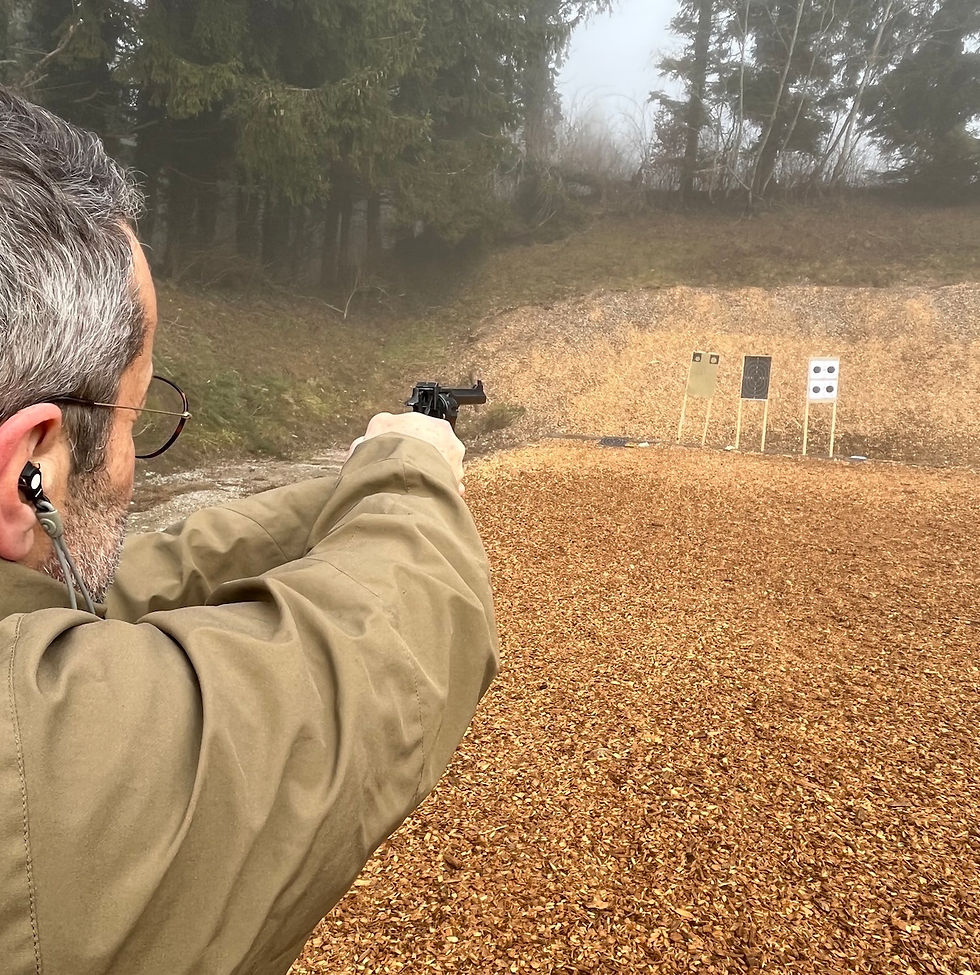
Ergonomics Test
The ergonomics test was originally developed in the 1970s by Ken Hackathorn and has been modified several times since. It consists of 10 rounds fired at a distance of 5 meters on a B-8 target (10-ring diameter approximately 8.5 cm). Each string of fire has a time limit of 3 seconds, with any overtime resulting in a 10-point penalty.
Weapon low, 1 round, 2 hands
Ready position, 4 rounds, 2 hands
Ready position, 3 rounds, strong hand
Ready position, 2 rounds, weak hand
Ergonomics and combat testing were conducted in a manner consistent with typical combat employment:
M1917 and Enfield No. 2: double-action only
P1 (Walther P38) and SIG Sauer P226: first round fired in double-action
M1911A1, TT-33 and Glock G17: single-action only
Scale
70 points: Sufficient
80 points: Good
90 points: Very good
Accuracy Test
The accuracy test consisted of 10 rounds fired at a distance of 25 meters on an Olympic target:
5 rounds fired without a time limit
5 rounds fired within 30 seconds (overtime penalty: –10 points)
Accuracy testing was conducted with the first round fired in double-action for all double-action semi-automatic pistols, and in double-action only for all revolvers.
Scale
70 points: Sufficient
80 points: Good
90 points: Very good
Combat Test
The combat test consisted of 20 rounds fired across four exercises at distances of 3, 5, 7, and 10 meters on a military combat target (center zone: 5 points; outside the center zone: 0 points). Each exercise had a time limit of 6 seconds, with any overtime resulting in a –10 points penalty.
3 m, weapon low, 1 step right, 3 rounds, 2 steps left, 3 rounds, one handed
5 m, weapon low, 1 round, 1 step right, 2 rounds, 2 steps left, 2 rounds, two-handed
7 m, weapon low, 1 round, 1 step left, 2 rounds, 2 steps right, 2 rounds, two-handed
10 m, ready position, 2 rounds standing, kneeling, 2 rounds, two-handed
Scale
70 points: Sufficient
80 points: Good
90 points: Very good

Miscellaneous
In addition to the technical evaluation, an informal drawing and reloading test was conducted with several of the weapons in order to obtain a comparative impression of handling characteristics. For the revolvers, original-pattern holsters and ammunition pouches were used. For the semi-automatic pistols, a generic tanker-style holster was employed, and the weapons were carried in a manner consistent with their typical historical condition of service (for example, theM1911A1in Condition 1 and the TT-33 in Condition 3).
Reloading drills for the single-action semi-automatic pistols followed the Second World War–era OSS magazine-change technique, specifically actuating the magazine release with the thumb of the left (support) hand. While not intended as a formal performance evaluation, these procedures provided useful qualitative insights into ergonomics, manual of arms, and reload efficiency across different handgun systems.
4. Results
As can be seen in the photographs, the tests were conducted on an outdoor range under sub-freezing temperatures. Consequently, lightweight gloves were worn for the majority of the testing.
The M1917 suffered a mechanical failure after the accuracy test and could unfortunately not be used for the subsequent testing.
Test | M1911A1 | M1917 | Enfield No. 2 | TT-33 Tokarev | P1 (P38) | SIG P226 | Glock G17 |
Ergonomy | 90 | - | 94 | 81 | 54*** | 88* | 96 |
Accuracy | 98 | 94 | 93 | 97 | 96 | 98 | 97 |
Combat | 95 | - | 95 | 75** | 90* | 100 | 90 |
Total | 283 | - | 282 | 253 | 240 | 286 | 283 |
Scale | Very good | - | Very good | Good | Good | Very good | Verygood |
* One overtime: minus 10 points
** Two overtimes: minus 20 points
*** Three overtimes: minus 30 points

5. Findings
Preliminary Remark
It is evident that test results are strongly dependent on the skill level of the shooter. Tier One Tactical conducted a comparable test involving over 200 participants, each firing at least one iteration with their own pistol and at least one iteration with a different model. Highly skilled shooters consistently performed well regardless of the pistol used, while less proficient shooters generally performed poorly across all platforms.
The largest group, the average shooters, tended to achieve better results with single-action or striker-fired pistols featuring good ergonomics. In that particular test, the CZ P-10 produced the best overall results for this group. This observation highlights the significant influence of trigger system and ergonomics on practical shooting performance, particularly for non-expert users.
Although I have extensive experience with firearms, my training frequency in recent years has been limited, and I do not have significantly greater familiarity with any one of the pistols tested. In addition, the test involved transitioning between markedly different ergonomics and trigger systems and was conducted without prior warm-up.
Trigger
As can be seen above, the best results were achieved with four pistols employing different trigger systems (one could reasonably debate whether the M1911A1 single-action trigger should be considered equivalent to the striker-fired system of the Glock G17). This suggests that it was not the trigger system itself that determined performance, but rather the characteristics of the trigger.
A crisp single-action trigger, as well as a smooth and reasonably short double-action trigger, allows for effective performance. In contrast, the very long and heavy double-action trigger of the P1 (Walther P38), along with the very heavy and notoriously inconsistent trigger of the TT-33 (the tested example in particular exhibited an exceptionally heavy pull), resulted in multiple overtime penalties and or bad accuracy.
Ergonomics
First, it must be stated that conducting the ergonomics test with pistols of very different designs proved highly interesting and instructive.
Unsurprisingly, the pistols that featured the best trigger characteristics also achieved the best results in the ergonomics test. However, pistols such as the M1911A1, the Enfield No. 2, and even the P1 (Walther P38) produced better groupings during the combat test. In contrast, the SIG Sauer P226 and the Glock G17 felt comparatively clumsy and uncomfortable, a sensation that was further amplified when wearing gloves.
This serves as a useful reminder that since the introduction of the FN GP35 (Browning Hi-Power), many large-frame combat pistols have been designed primarily around magazine capacity rather than hand ergonomics—particularly for shooters with medium to small hands.
One issue with older semi-automatic pistols such as the M1911A1 or the TT-33 is the relatively small size of the trigger guard, which can hinder rapid placement of the finger on the trigger when employing a safety technique that keeps the finger indexed along the frame, particularly in the case of the TT-33.
Accuraccy
The accuracy of all pistols was sufficient to reliably hit an A4 (ca. 20 × 30 cm) target at 25 meters and was therefore more than adequate for combat use.
Recoil
Recoil was also a determining factor in the results, particularly when firing one-handed. The stronger recoil of the .45 ACP in the M1911A1 and M1917, as well as the 7.62×25 mm cartridge of the TT-33, made these weapons more difficult to control. In contrast, the softer recoil of the .38 S&W cartridge used in the Enfield No. 2 facilitated weapon control and, when combined with its relatively good double-action trigger, contributed to the high scores achieved.
As is well known, pistols with a low bore axis, as well as smaller frame sizes, are generally more favorable for recoil control. In fact, were it not for its poor trigger, the TT-33 would likely have performed very well, as it was otherwise comfortable to handle.
As mentioned earlier, many modern high-capacity pistols suffer from poor ergonomics for shooters with medium to small hands. The extensive aftermarket market for grip modifications for pistols such as the Glock and SIG P320 serves as clear evidence of this issue (the latest Glock Gen 6 show a marked improvement in grip ergonomics compared to earlier generations). This is also likely one of the reasons why smaller-frame pistols, such as the SIG P365, have gained significant popularity.
It is therefore unsurprising that, in the aforementioned Tier One Tactical test, the .32 ACP Colt 1903 Pocket Hammerless produced very good results, owing to its favorable ergonomics and mild recoil.
Reloading
As mentioned earlier, reloading was not part of the formal comparison and was conducted in an informative, qualitative manner. It comes as no surprise that revolvers are slower to reload, particularly the Enfield No. 2, for which ammunition was typically carried loose. Under stress, this makes it easy to drop cartridges during reloading. In contrast, the use of half-moon clips with the M1917 provides a significantly more efficient and practical alternative.

As is well known, there are generally two pistol reloading techniques: the speed reload and the tactical reload, the choice of which depends on whether the weapon is empty and, more importantly, on the tactical situation. The question I wish to address here is whether a high-speed reload performed while standing in place after the weapon runs empty is actually required. In most cases, this is probably not realistic. More often, the shooter will move to cover or reposition, and in such situations the practical differences between the two reloading techniques become less pronounced.
Of course, a push-button magazine release combined with a free-dropping magazine is faster. However, when reloading on the move or from cover, pistols with non–free-dropping magazines or a heel-mounted magazine catch (as found on the P1) can still represent a perfectly viable option, in my opinion. Once again, this brings us back to the need to clearly understand and define the operational requirements.
6. The elephant in the room
Let us address the elephant in the room: safety. Many will argue that older pistols lack adequate safety features and are therefore unsafe to carry. I hold a different view, which I will develop below.
When examining modern pistols, two categories of safety mechanisms can generally be distinguished: drop safety and what might be described as operational safety. It is a fact that most pistols designed prior to the 1970s did not incorporate a dedicated drop safety. I will not argue here whether such a feature is strictly necessary, but it is worth noting that drop safeties are typically engineered to function only up to a specified drop height, generally around one meter. If a pistol is dropped from a greater height, an unintentional discharge may still occur.
Now let us turn to operational safety. I often remark—half-jokingly—that Gaston Glock deserved a marketing award for successfully presenting the Safe Action pistol as inherently safer than the previous generation of SA/DA pistols. I still remember how, in the 1980s, the M1911A1 was frequently criticized as unsafe because it was carried with the hammer cocked, in contrast to the then-fashionable SA/DA pistols. This criticism was largely misplaced, as the M1911A1 incorporates both a manual thumb safety and a grip safety.
Most modern striker-fired pistols rely on a combination of a trigger safety, typically a lever integrated into the trigger, with notable exceptions such as the Bubits-Arms pistol, which features a lever below the trigger guard, and a partially or fully pre-tensioned firing pin (striker). As a result, the only true operational safeties are the trigger safety itself and strict trigger discipline—keeping the finger off the trigger. The striker-fired SIG P320, for example, does not feature a trigger safety lever at all. From an operational-safety perspective, this is functionally comparable to carrying a SIG P226 with the hammer cocked, or if one disregards drop safety considerations, even similar to carrying a Tokarev TT-33 with the hammer cocked.
Few would consider such carry conditions acceptable. In this context, it is worth noting that even a M1911A1 carried with the manual safety disengaged still benefits from the grip safety, providing an additional layer of operational safety that many modern striker-fired designs lack.
7. Conclusions
This comparison of various 20th-century pistols has shown, first and foremost, that the most important factor remains the skill of the shooter.
At the same time, it demonstrated that trigger characteristics, recoil, and—no less importantly—ergonomics are critical factors when evaluating and testing a combat pistol. The ergonomics test proved particularly valuable in highlighting the differences between the pistols. Nevertheless, all of the pistols tested remain viable combat weapons (although, in the case of the TT-33, a specimen with a better trigger would certainly be preferable).
Today, too much emphasis is placed on technical features—an effect further amplified by social media and marketing—while insufficient attention is given to understanding and clearly defining operational requirements.
Unfortunately, the current military pistol market is overly driven by high-capacity designs, often under the assumption that “more is always better,” while other equally important factors receive far less consideration. Greater emphasis should instead be placed on trigger characteristics, a low bore axis, and good grip ergonomics, including suitability for shooters with smaller hands. These characteristics are best embodied today by pistols such as the Glock G17 Gen 6 and its derivatives, as well as the CZ P-10, as mentioned earlier.
As for safety, it is important to understand the actual function of specific safety mechanisms rather than being guided by marketing claims or by the equipment choices of special forces units, which generally benefit from far more extensive weapons training.
I am aware that many of the opinions expressed here are controversial and may irritate some readers. Nevertheless, I hope this comparison proves engaging and helps broaden perspectives on military combat pistols.


Comments