
Franchi LF-57 - A Submachine Gun Becomes a Saint

Introduction
The origins of the submachine gun are closely associated with Italy and the Villar Perosa, developed during the First World War. Originally conceived as a lightweight, twin-barrelled automatic weapon firing pistol-calibre ammunition, it saw extensive service with the Italian Army and was notably employed by the Arditi, Italy’s elite assault troops, during the brutal trench warfare of the conflict. I know, I know, some will argue that the Germans deserve the credit, and that their Bergmann MP 18 was the first true, practical submachine gun. And, admittedly, they have a point.

Italy entered the Second World War equipped with the Beretta Model 38 (Moschetto Automatico Beretta Modello 1938), one of the finest examples of the first generation of submachine guns. Like many weapons of this generation, it featured a traditional wooden stock and extensively machined steel components. This method of construction produced a robust, well-finished weapon, but also made it relatively heavy, expensive, and time-consuming to manufacture. The Beretta Model 38 was no exception, weighing approximately 4.2 kg (9.3 lb).

Unlike several of the other major belligerents, Italy did not make the same clear transition to a radically simplified second generation of submachine guns, exemplified by Germany’s MP 40, Britain’s STEN, and the Soviet PPS-43. Instead, Beretta progressively simplified and streamlined the existing Model 38 design. This evolution resulted in the Model 38/42, a lighter and less costly weapon that dispensed with some of the refinement of its predecessor and weighed approximately 3.25 kg (7.2 lb). The Germans also made extensive use of the Beretta during the war, designating the Model 38/42 the MP 738(i) (Maschinenpistole 738 italienisch).

Italy continued to develop and simplify the Beretta design throughout the war, while several other submachine guns were developed and produced in relatively small numbers. As these weapons fall outside the main scope of this article, they will not be discussed further here.
Italy effectively made the transition to a new generation of submachine guns in the mid-1950s, when Luigi Franchi developed a compact and thoroughly modern design that entered production in 1957 as the Franchi LF-57 - the initials “LF” standing for Luigi Franchi. The LF-57 represented a considerable departure from the traditional construction of Italy’s wartime Beretta submachine guns and embodied the compactness and simplified construction associated with post-war, third-generation designs.
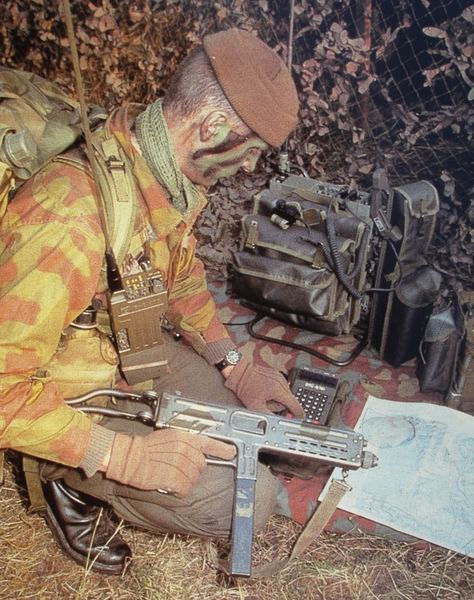
The LF-57 was acquired by the Italian Army in limited quantities and was issued, among others, to the 13th “Aquileia” Target Acquisition Group (13° Gruppo Acquisizione Obiettivi, Gr.Ac.O.). In 1962, it was also supplied to COMSUBIN, the Italian Navy’s special-operations force. Its service was relatively short-lived, however, as it was soon overshadowed and largely replaced in Italian service by the Beretta PM12.
The Portuguese Army also acquired approximately 10,000 LF-57s, which were used primarily during the Portuguese Colonial War in Angola, Mozambique, and Portuguese Guinea (present-day Guinea-Bissau). Some of these weapons also found their way into the hands of mercenaries operating in the Congo during the turbulent years following the country’s independence from Belgium in 1960, particularly during the Congo Crisis.

Description
The Franchi LF-57 belongs to the so-called third generation of submachine guns developed after the Second World War. These weapons were characterized by two important developments: the telescoping, or enveloping, bolt, which permitted a more compact overall design and/or the use of a longer barrel for a given weapon length, and the introduction of improved safety mechanisms. Other representative examples of this generation include the Israeli UZI and the Czechoslovak Sa vz. 23 series.

The LF-57 is constructed largely from stamped sheet-steel components, reflecting the emphasis on simplified and economical manufacture characteristic of post-war submachine-gun design. Its folding stock consists of a bent and shaped steel tube, while the large trigger guard facilitates handling when wearing gloves. The weapon uses the well-proven Beretta Model 38 pattern of magazines, available in 10-, 20-, 30-, and 40-round capacities.
The LF-57 is equipped with a cross-bolt fire selector located above the trigger, allowing the user to select either semi-automatic or fully automatic fire. In fully automatic fire, the weapon has a particularly low cyclic rate of approximately 460 rounds per minute. The cross-bolt selector is operated laterally: pushing it from left to right selects semi-automatic fire, while pushing it from right to left selects fully automatic fire.
In the early 1990s, a lesser-known variant was developed for the Italian Army. This version replaced the cross-bolt selector with a more conventional fire-selector lever positioned above the pistol grip. It was designated LF-57 RAFF-C.S., standing for Raffica e Colpo Singolo (“Automatic Fire and Single Shot”).
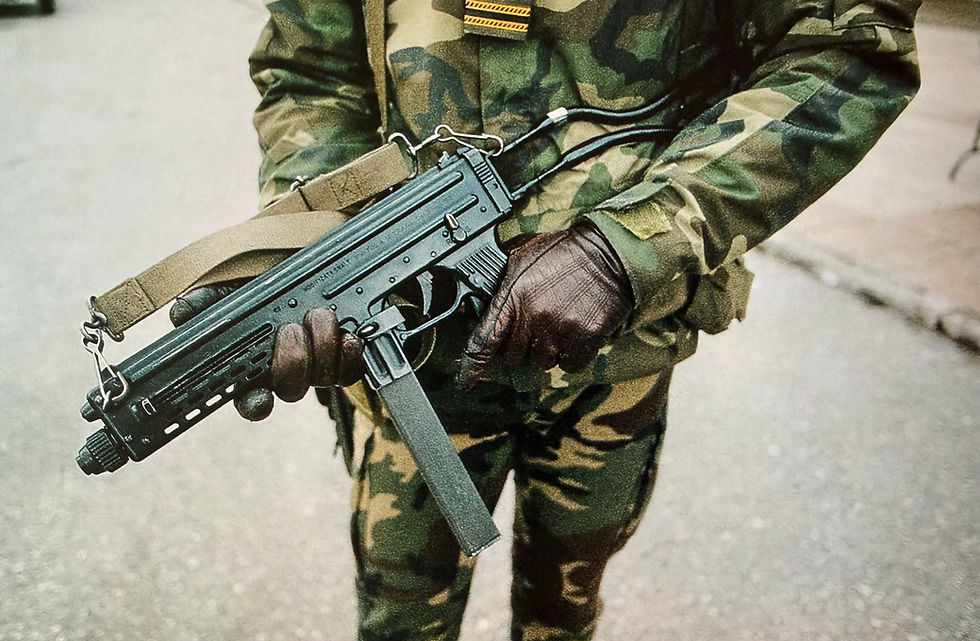
The LF-57 weighs 3.3 kg (7.3 lb) unloaded and approximately 3.8 kg (8.4 lb) fully loaded with a 30-round magazine fitted. It measures 680 mm (26.8 in) in overall length with the stock extended and 420 mm (16.5 in) with the stock folded.
The weapon does not have a separate manual safety lever in the conventional sense. Instead, it incorporates a prominent grip-safety pedal at the front of the pistol grip, which must be depressed when the weapon is held normally.
The weapon operates on an open-bolt, blowback system. Although it does not feature a true telescoping bolt, the massive bolt carrier extends over the rear portion of the barrel, shifting much of the reciprocating mass forward and contributing to a more compact overall design and improved balance. The non-reciprocating cocking handle is located on the left side of the weapon.
The grip-safety pedal also provides an important measure of protection against accidental discharge. When the safety is not depressed, it restricts the rearward movement of the bolt, helping to prevent an unintended discharge if the weapon is dropped on its stock.
The magazine release is particularly noteworthy. It consists of a lever located on the left side of the magazine well, which is pushed upwards to release the magazine. This type of arrangement is relatively uncommon and bears some resemblance to the magazine release of the Thompson submachine gun, although on the Thompson the release lever is positioned behind the trigger guard.

The sights of the LF-57 are very rudimentary, consisting of an unprotected front blade and an equally unprotected rear notch sight. The sights are factory-set for a range of 50 metres, although the rear sight permits minor lateral adjustment.

At first glance, the Italian Franchi LF-57 bears a striking visual resemblance to the Walther MPK/MPL submachine guns. However, the chronology is worth noting: the LF-57 appeared several years before the Walther MP series, which was introduced in 1963. Therefore, if the resemblance reflects any direct influence rather than simply convergent design, that influence could only have run from the earlier Franchi design to the later Walther, not the other way around.
At the range
The first thing that strikes you when handling the Franchi LF-57 is its compactness. Measuring just 420 mm with the stock folded, it is shorter than the Israeli UZI (470 mm) or the Czechoslovak Sa 23/25 (445 mm). At the same time, its compact dimensions make it feel surprisingly heavy, despite weighing only 3.3 kg. Nevertheless, the weapon is well balanced and easy to handle.
Loading the Beretta M38-pattern magazine is straightforward thanks to its double-column, double-feed design. Although the magazine release initially feels rather stiff, it is easy to operate, and magazines can be inserted and removed without difficulty.
The folding stock uses a spring-loaded detent mechanism to retain it securely in either the fully extended or folded position. There is no separate release lever: the stock is simply moved between the two positions by applying sufficient sideways pressure to overcome the spring-loaded detent.
The sights are very rudimentary and resemble those of a pistol rather than a submachine gun. However, obtaining a proper sight picture requires pressing your cheek firmly against the stock. Alternatively, you can position your head further back along the stock, although this is neither particularly comfortable nor practical.
Lets load and fire!

The Franchi LF-57 is a remarkably pleasant and controllable submachine gun to shoot, thanks to its compact design and very low cyclic rate of approximately 460 rounds per minute.
The folding metal stock provides adequate stability, although the absence of a positive locking mechanism creates a risk of it folding unintentionally. Nevertheless, the weapon’s straightforward ergonomics, simple controls and reliable double-column, double-feed magazine contribute to its ease of handling and overall practicality.
Shooting the Franchi LF-57 is a rather different experience from firing most other submachine guns, even the superficially similar Walther MPK.
“Canonisation” – The Legend of San Luigi
The Franchi LF-57 also acquired a reputation among mercenaries operating in the Congo during the turbulent years following the country's independence from Belgium. Portuguese mercenaries were reportedly among those who carried the weapon, appreciating its ruggedness, affordability, reliability and controllability during automatic fire.
One particularly colourful anecdote even earned the LF-57 the unlikely nickname “San Luigi” (“Saint Luigi”). According to the story, a group of missionary sisters found themselves in a dangerous situation during the Congo Crisis and were rescued by mercenaries armed with LF-57 submachine guns. Since the letters “LF” stood for Luigi Franchi, the grateful sisters supposedly dubbed their unlikely saviour - and, by extension, his weapon - “San Luigi”.
Whether entirely factual or embellished over the years, the anecdote illustrates the reputation the LF-57 acquired among mercenary forces operating in Africa: that of a simple, robust, inexpensive and reliable submachine gun well suited to the harsh conditions in which they fought.


Comments